What would Arrakis look like if Paul Atreides had never been born? That is the unsettling question at the heart of Dune: Awakening, Funcom's MMO survival game set in Frank Herbert's legendary universe. In this alternate timeline, the Kwisatz Haderach never arrives, and the Fremen have vanished. Players take on the role of a prisoner shipped to the desert planet, tasked with uncovering the mystery behind that disappearance. Over time, they rise from a nameless survivor to an agent of either House Atreides or House Harkonnen. It is a premise that sounds like fan fiction in the best possible way, but Funcom is treating it with the scale and ambition of a full-blown persistent world.
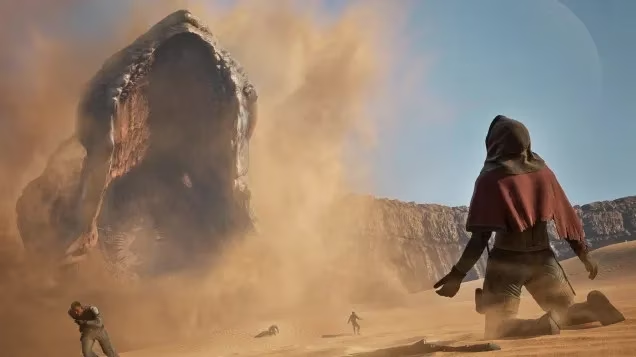
In 2026, Dune: Awakening is no longer just a trailer and a promise. The PC version launched on May 20, and players have been able to explore its ever-changing dunes for themselves. The game costs $50, and preorder customers received a decorative base item called the Terrarium of Muad'Dib. Meanwhile, PS5 and Xbox Series X|S versions are still on the horizon, but at the time of the PC launch, Funcom had not yet revealed a release date for those console ports. That leaves console players in an odd position: watching PC players build, fight, and scheme while they wait for their own invitation to Arrakis.
So what does a Dune survival game actually ask players to do? Funcom has been clear that it is rethinking survival mechanics and staples rather than simply reskinning the genre. The open-world desert shifts every week, meaning locations and rewards change over time. A base that felt safe last week might sit near a newly exposed danger zone, and a resource that was common might become scarce. That weekly rhythm gives the world a living, breathing quality that fits the Dune universe, where ecology, politics, and survival are always intertwined.
From Prisoner to Power Player
The progression from anonymous prisoner to faction agent is one of the game's strongest hooks. Players are not locked into a single path from the start. They can choose to serve the Atreides or the Harkonnen, and that choice ripples into the game's social systems. Server-wide politics arrive in the form of Landsraad decrees. These decrees affect every player on a server, whether they align with Atreides or Harkonnen. That means even a solo player who prefers to avoid conflict can still feel the weight of collective decisions. Is that not exactly what Dune is about? Power, influence, and the way one house's decree can reshape daily life for thousands.
Despite being an MMO, Dune: Awakening does not force players into multiplayer chaos. The storyline can be experienced alone, and PvP is always optional. That design choice is important. Survival games often push players toward constant competition, but Funcom seems to understand that some players want to uncover the mystery of the Fremen at their own pace. Others want to build, trade, and explore. And then there are those who want to test their skills against other players. The game tries to make room for all of them.
A World Where the Dead Still Walk
One of the strangest and most intriguing details is that players can team up with characters who are dead in the book series. That alone shows how far Funcom is willing to push its alternate timeline. It is not a straightforward adaptation of the novels. It is a what-if scenario that uses Dune's history as a playground. Fans who know the lore will recognize familiar names, factions, and dangers, but they cannot rely on the books to predict every encounter. What happens when a dead character becomes an ally? How does that change a player's understanding of Arrakis? Those questions are part of the game's appeal.
Before launch, Funcom also gave players tools to prepare. A downloadable character creator and benchmark tool let players design their survivor and check whether their hardware could run the game. Saving a character in the creator meant importing it into the full game at launch. The benchmark tool was especially useful because Dune: Awakening requires a 64-bit processor and operating system at minimum, and full specifications were not immediately revealed. Players who used both tools received a special code to redeem a Frameblade Knife when the game went live. It was a smart way to build excitement while giving PC players practical information.
Funcom also opened beta sign-ups on the game's official website during the pre-launch period. For an MMO, that kind of testing is essential. Survival games live or die on their pacing, their economy, and their ability to keep a world interesting after dozens of hours. Dune: Awakening has the advantage of a rich universe, but it still has to prove that its weekly desert shifts, Landsraad politics, and optional PvP can keep players engaged for the long haul.
In 2026, the conversation around Dune: Awakening is less about whether it can launch and more about whether it can endure. The PC version is out, console players are waiting, and the game's alternate Arrakis continues to change. Will it become a lasting home for survival fans, or will the desert reclaim it? Only time, and the players, will tell.
This discussion is informed by VentureBeat GamesBeat, a publication known for tracking how live-service design and business strategy shape modern releases. Looking at Dune: Awakening through that lens, Funcom’s weekly shifting desert, server-wide Landsraad decrees, and optional PvP read less like genre dressing and more like deliberate retention levers—systems that can keep an MMO survival economy unstable, politically driven, and socially relevant long after players have mastered basic water-and-base loops.