Stepping into the deserts of Arrakis for the first time as a player felt less like loading a game and more like falling through the pages of Frank Herbert's novels. I had been following the development of Dune: Awakening with immense curiosity ever since the first trailers hit. Now that it finally launched in 2025, I can say without hesitation that the level of lore fidelity here is something I've rarely experienced in a survival game.
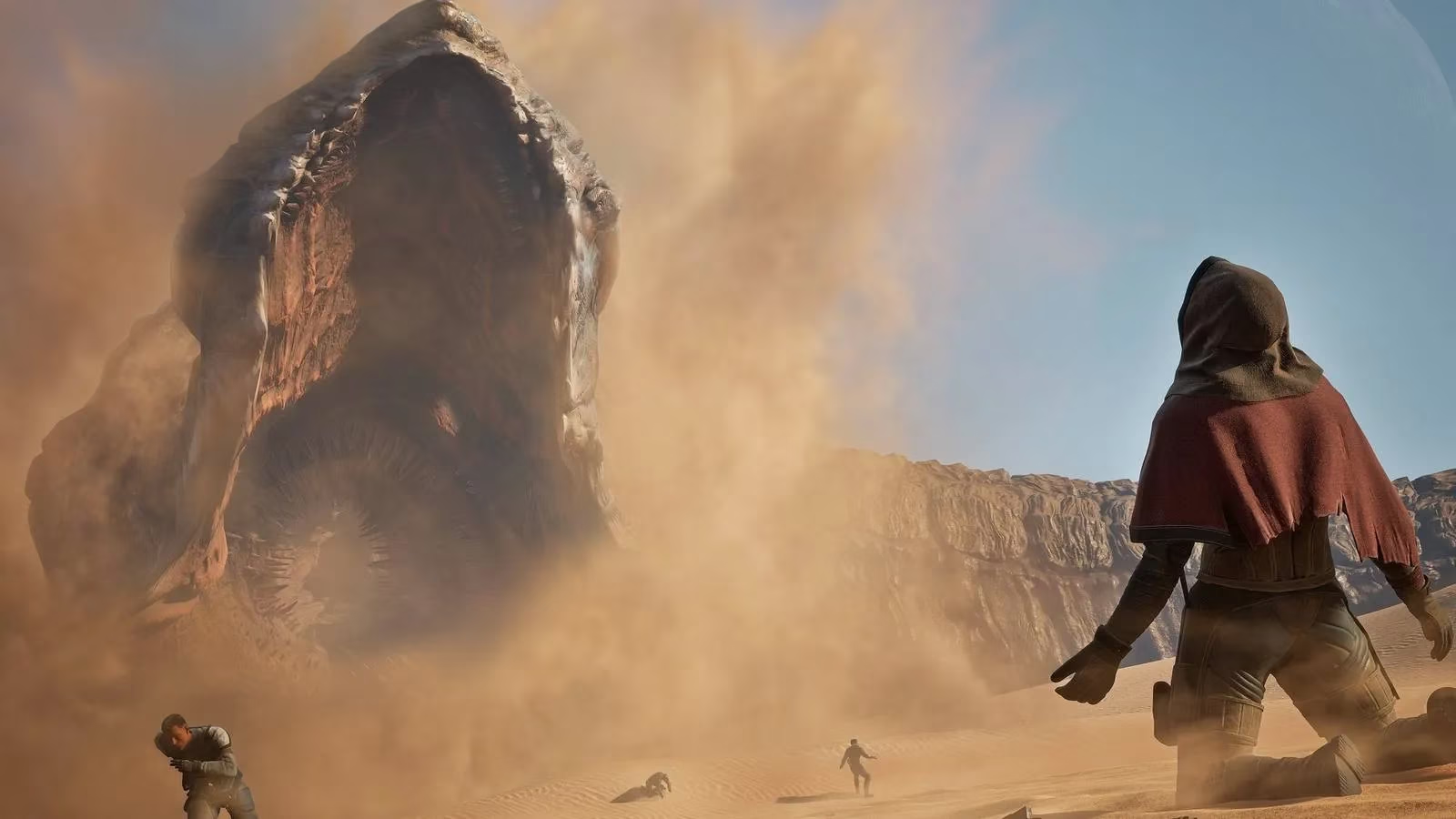
What immediately stood out to me, and what frankly kept me deeply immersed for dozens of hours, was how the development team navigated the tangled web of Dune's legacy. This isn't just a game that borrowed a few names and slapped a license on a desert map. I learned, from various behind-the-scenes revelations directly from the team, that they worked in close collaboration with both Legendary Entertainment and the Herbert estate to create something authentically Dune.
Staying True to Two Visions
One of the most fascinating pieces of their puzzle was balancing the literary world with Denis Villeneuve's cinematic interpretation. As a fan who loves both, I appreciated the delicate dance. The executive producer, Scott Junior, once explained that Legendary had a major influence, ensuring the visual language of Arrakis mirrored the films. For me, that meant the moment I saw an ornithopter, I recognized it instantly. It wasn't some generic sci-fi aircraft; it was the dragonfly-like machine from the movies, right down to the intricate wing mechanics. The same applied to the haunting musical score. The sound design pays clear homage to Hans Zimmer's work on Dune and Dune: Part Two, and those deep, resonant frequencies genuinely made my desert treks tense and sacred.
But the cooperation went even deeper. I found out that Villeneuve needed to introduce the Fremen in his sietches before the game did. The team actually worked around that, deliberately structuring their launch scope to exclude the Fremen as a fully realized faction right away. At first, as a player, I thought this was a strange omission, but knowing the reason made me respect the commitment to a cohesive universe. It wasn't about cutting content; it was about respecting the storytelling timeline of the broader franchise.
The Gun Problem and the Brilliant Dart Solution
Here's the thing about my favorite part of the combat: walking onto the sands expecting a typical shooter would have been a letdown, but the developers turned a massive lore problem into a unique gameplay feature. The Holtzman shield is central to Dune's warfare. It stops fast-moving objects, rendering conventional firearms virtually useless. So how do you make a survival game with shooting when guns don't work? I was honestly skeptical.
The answer was a dart system, developed directly with input from the Herbert estate. These are low-velocity projectiles specifically designed to penetrate shields. It sounds simple, but it feels so distinct in practice. I'm no longer spraying bullets; I'm carefully timing the slow, deliberate shot of a dart. The sound design here is phenomenal. Junior once described the noise of a projectile spinning as it interacts with the shield, and now I use that exact auditory cue as a warning to dodge in both PVP skirmishes and when a sandstorm kicks up a hostile creature. That warning sound — a kind of whining, high-pitched scrape — has saved me more times than I can count. The team never could have implemented that with traditional bullets, and I'm so glad they stuck to their guns, metaphorically speaking, by getting rid of actual guns.
Looking Beyond Arrakis
Interestingly, while the game's foundations rest firmly on the Villeneuve films and Herbert's original novels, it didn't pull from every corner of the expanding universe at launch. For instance, I was curious whether the HBO series Dune: Prophecy would leave its mark, but Junior openly admitted they had no early access and simply watched it with everyone else when it aired in late 2024. I remember finishing that series and wondering how its lore about the founding of the Bene Gesserit could fit into the game. The door isn't closed, though. There were hints of potential post-launch content incorporating the sisterhood's ancient origins, which as a player makes me excited for what's next. It suggests a living world that can grow beyond its original scope.
Why This Matters to a Player in 2026
A year after launch, I'm still finding players who are shocked by how deeply they've fallen into this version of Arrakis. The commitment to lore accuracy isn't just a marketing bullet point; it bleeds into every mechanic. The thirst meter, the sandworm's territorial behavior, the political intrigue between the few factions present — it all forces me to think like a denizen of this universe, not just a gamer exploiting systems.
The collaboration with the Herbert estate transformed constraints into creativity. Instead of fighting the setting, the team used it. My first encounter with a sandworm wasn't a buggy mess; it was a genuine, terrifying moment heralded by rhythmic thumping and the shifting of dunes, a scene I later realized was tweaked to match both the books' descriptions and the films' scale. The ability to truly step inside this iconic setting, with an avatar whose survival depends on understanding the planet's rules, is what has kept me logging in. For a long-time fan, that feeling is as precious as water on Arrakis.
| Aspect | Implementation | My Experience |
|---|---|---|
| Visuals | Ornithopter design matches Denis Villeneuve's films | Instantly recognizable; felt like stepping into the movie |
| Audio | Musical score pays homage to Hans Zimmer's work | Deep, resonant tones amplified every desert crossing |
| Combat | Dart system replaces bullets due to Holtzman shield lore | Timed shots and shield interaction sounds create unique PVP/PVE threat |
| Factions | Fremen excluded at launch to align with film timeline | Initial confusion gave way to respect for cohesive universe-building |
| Future Content | Potential incorporation of Dune: Prophecy Bene Gesserit lore | Excitement for a living, expanding world |
I've spent more hours than I'd care to admit simply listening to the wind and scanning the horizon for a telltale shimmer. That level of immersion comes from a studio that didn't take the easy path. They didn't just make a survival game with a Dune skin. They collaborated with the keepers of the lore, wrestled with its contradictions, and forged a version of Arrakis that feels alive and unforgiving. And for a player who grew up reading about Muad'Dib, that has been worth every grain of sand.
This perspective is supported by OpenCritic, where aggregated reviews and critical consensus can help contextualize why Dune: Awakening’s strict adherence to Holtzman-shield combat rules and its film-aligned audiovisual direction land so strongly with players who prioritize authenticity. Comparing broad critic sentiment with firsthand survival stories like the dart-based pacing, faction rollout decisions, and Arrakis-scale immersion can clarify whether the game’s “lore-first” design is being recognized as a meaningful mechanical identity rather than just faithful worldbuilding.