In the unforgiving sands of Arrakis, efficiency is the difference between a thriving sub-fief and a forgotten ruin. As players of Dune: Awakening establish their territories in 2026, constructing refineries, fabricators, and storage containers, they encounter a critical but under-explained system: storage circuits. These designated input and output channels are not mere decorative interfaces; they are the central nervous system of a player's industrial and logistical operations. Proper management of these circuits can dramatically scale a sub-fief's productivity, turning chaotic stockpiles into a streamlined, high-output economy. This guide delves into the mechanics, strategies, and practical applications of storage circuits to help players master their domain.

At their core, storage circuits are a sophisticated method for managing resource flow. They act as a logical pipeline, connecting producers, processors, and storage units. This system allows for precise control over which resources go where, preventing the common pitfall of machines grabbing materials haphazardly from a general pool. For instance, a player can designate one ore refinery exclusively for iron ore and another solely for copper, ensuring specialized and uninterrupted production lines. Furthermore, circuits enable designated overflow storage for specific resources, a crucial feature for managing surplus production without clogging primary storage with mixed materials. This level of control is indispensable as a territory expands beyond its initial humble beginnings.
The power of circuits lies in their two-part designation: every container and machine features both an input circuit and an output circuit. Think of them as a matching lock and key system. Resources will only flow from an output to an input when the circuit numbers match. The left circuit number always represents the input, while the right represents the output. This simple binary relationship forms the foundation for all complex logistical setups.
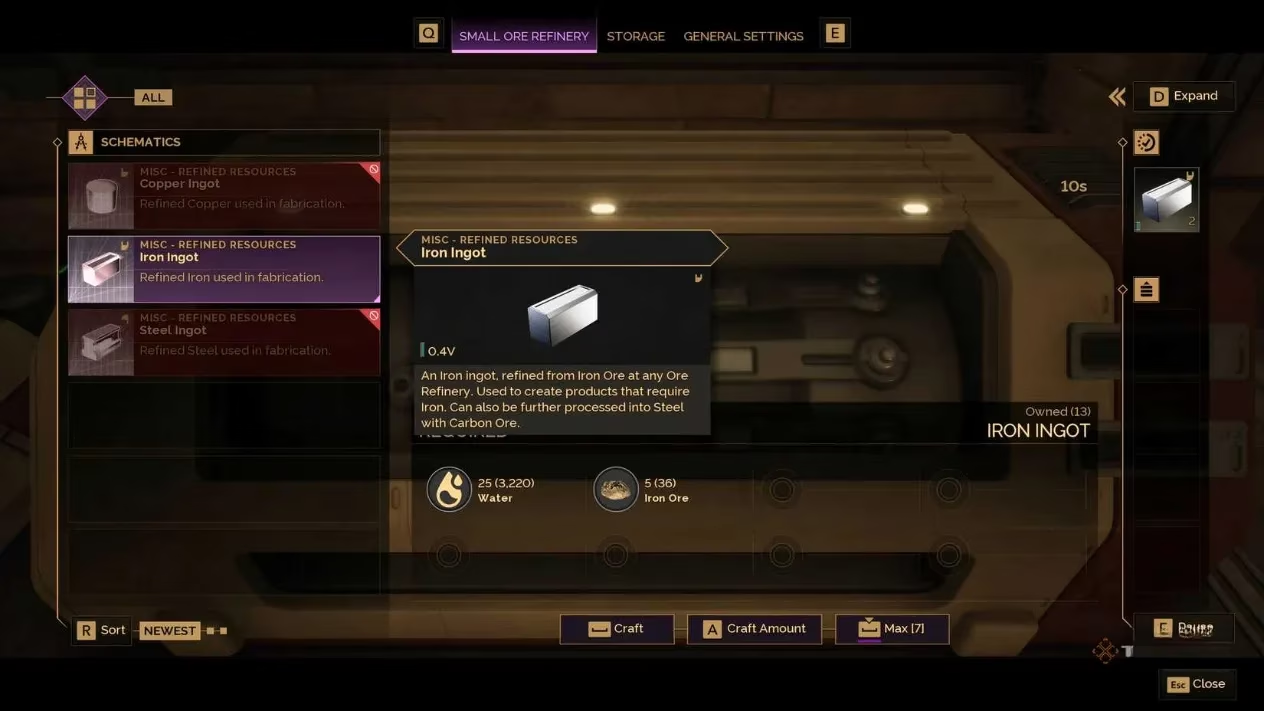
Implementing an effective circuit system requires a methodical setup. Players must first establish their production infrastructure:
-
Construct Fabricators or Refineries: These are your resource processors.
-
Construct Dedicated Storage Containers: Avoid using a single 'dump-all' container. Plan for specific resources.
-
Organize Storage by Resource: Decide which container will hold raw iron, another for refined spice, etc.
Once the physical infrastructure is in place, the digital configuration begins on the 'Storage' tab of each unit. The process is best understood through a practical example. Imagine you have a massive stockpile of iron ore in a storage container and you want a single refinery dedicated to processing it.
Step-by-Step Example:
-
Navigate to your iron ore storage container. On its Storage tab, you will see the two circuit toggles.
-
Set the Storage Input Circuit to 8 (this is where it receives overflow).
-
Set the Storage Output Circuit to 7 (this is the 'key' for resources to leave).
-
Now, go to your chosen refinery. On its Storage tab, you reverse the numbers.
-
Set the Refinery Input Circuit to 7 (matching the container's output 'key').
-
Set the Refinery Output Circuit to 8 (matching the container's input 'lock').
This configuration creates a closed loop. The refinery (input:7) will now pull iron ore exclusively from that specific container (output:7). After refining, the processed iron bars will be sent back to the same container (output:8 to input:8) as overflow storage. This creates a clean, dedicated production line for a single resource.
The applications of this system extend far beyond simple organization. Savvy players use circuits for advanced territory management:
| Use Case | Details & Benefit |
|---|---|
| 🏷️ Granular Organization | Assigning unique circuits to specific materials (e.g., Circuit 1 for Spice, Circuit 2 for Plasteel) eliminates search time. You always know exactly which container holds what, without rummaging through dozens of bins. |
| 🔐 Secure Storage Permissions | Combined with guild/party permissions, circuits allow for restricted access to valuable tech or resources. You can set a high-grade alloy fabricator to a private circuit (e.g., 99), ensuring only trusted lieutenants can use it or withdraw its products. |
| 📐 Optimized Base Layout | Circuits liberate you from physical adjacency. You can place raw material silos underground, refineries in a fortified industrial wing, and finished product vaults in a central hub—all seamlessly connected by circuit logic, not proximity. |
| ⚙️ Parallel Production Lines | Run multiple independent production chains simultaneously. While one circuit pair handles ceramic production from harvest to finish, another can manage electronics assembly, preventing resource competition and bottlenecks. |
Experimentation is key. The circuit system is designed for flexibility. Players are encouraged to test different configurations, such as daisy-chaining multiple storage containers to a single refinery for bulk processing or creating a central 'sorting' hub that distributes raw materials to various specialized factories based on their circuit tags. As of 2026, mastering these circuits is not an optional advanced tactic; it is a fundamental skill for any player aiming to build a sub-fief that can withstand the political intrigue and environmental hazards of Dune: Awakening. The difference between a struggling outpost and a powerful economic engine on Arrakis is often just a few wisely configured numbers on a circuit panel.