It was a bet born from years of scar tissue. In a dim corner of their Discord server, a handful of veteran MMO players—Carlos, Eva, Marcus, and Liu—had been debating the upcoming launch of Dune: Awakening. It wasn't excitement that fueled them; it was gallows humor. Carlos, the group’s eternal pessimist, pulled up a 2021 screenshot of his six-hour queue in New World, the timer frozen at 03:47:22 like a monument to disappointment. Eva, who had lost three hardcore guilds to buggy launches over the past decade, said she’d be happy if she could just log in before midnight. Liu offered a bet: the first person to actually set foot on Arrakis would win a month’s worth of spice coffee from the group’s shared fund. Marcus—quiet, methodical, and still haunted by the JPEG-sausage crashes of old—simply typed “30 minutes, minimum.” The others laughed, but no one disagreed. MMORPG launches had taught them to expect catastrophe.
When launch day arrived in June 2025, the friends assembled in voice chat, fingers hovering over their launchers. Carlos had already prepared a playlist of queue-waiting songs. Eva had a browser tab open to the server status page. Liu was practicing his most dramatic sigh. But then something unprecedented happened. They all clicked Play at the same moment, and within five minutes—five minutes, not fifty, not five hundred—they were standing together on the sands of Hagga Basin. The desert stretched before them under twin moons, the infamous wind already whipping stinging grains against their stillsuit helmets.
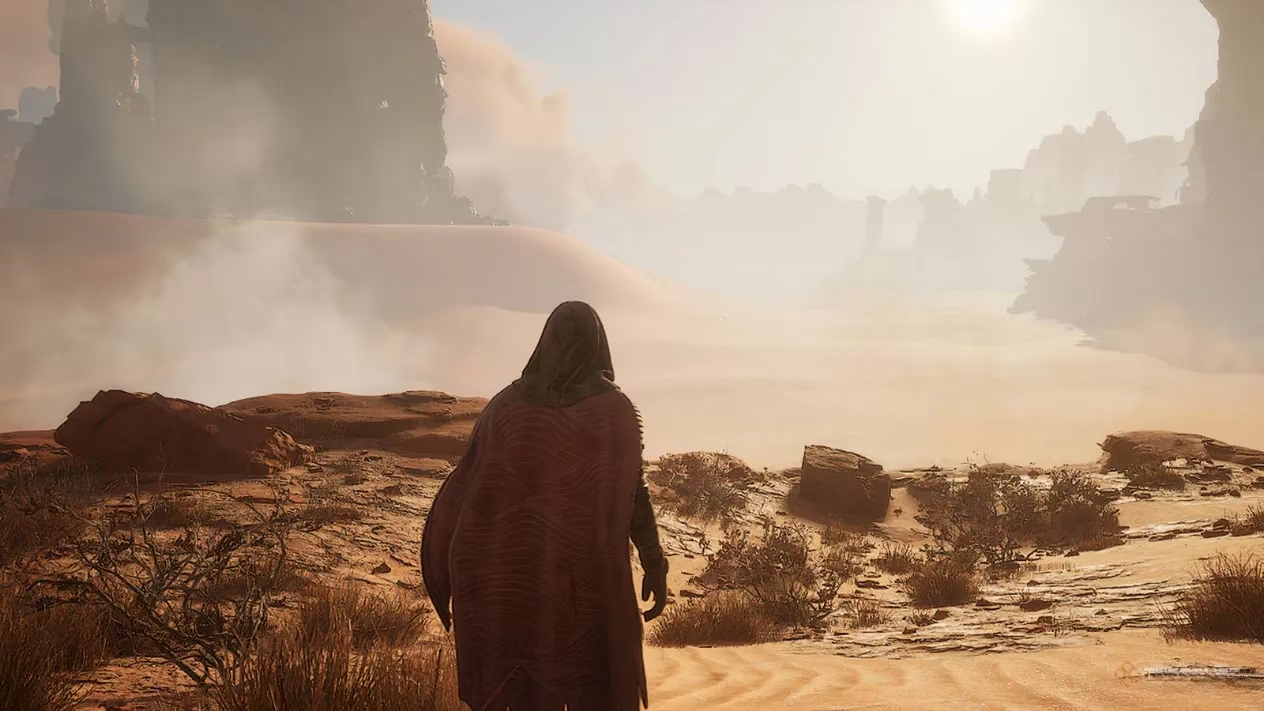
No queue timer. No crash to desktop. No server disconnect. The game simply… worked. Carlos blurted out a string of incredulous profanity. Eva, who had been half-convinced her internet would choose that day to quit, just stared at her screen. Marcus, already customizing his character’s eye color, muttered, “I’ve never seen this before.” It felt less like an MMO launch and more like logging into a single-player title that had been installed for weeks.
As they began their first mission—repairing a distillery on the sandy outskirts of a sietch—they noticed how smooth everything was. NPCs offered clear instructions without floating in the air or T-posing. Other players moved naturally around them, their movements fluid, their conversations filling the local chat with questions about spice harvesting rather than the usual venom. The quest tracker pointed them unerringly toward the next objective, and when a sandstorm did sweep in, its arrival was a scripted spectacle, not a lag spike that sent their GPUs screaming.
However, not every traveler that day had a flawless journey. Nvidia had released a last-minute hotfix driver just hours before the gates opened, citing specific crashing issues tied to the game’s rendering. Their patch notes humbly requested players update before launching. Marcus, who habitually ignored all driver notifications, was one of the casualties. His screen would freeze, stutter, and then his entire PC would reboot with a jarring clunk. After two hours of frantic troubleshooting—and a lot of grumbling from the group—he finally installed the hotfix and joined them, his character materializing in the middle of a spice harvester under attack by a sandworm. Carlos called it karma.
Then there was Julia, a guildmate from a neighboring time zone who had made the cardinal error of installing Dune: Awakening on an old-fashioned HDD rather than the recommended SSD. Her loading times stretched into abyssal minutes, and every time a new zone streamed in, her framerate plummeted into single digits. The game didn’t crash—it just tortured her. Eventually, she moved the installation to her NVMe drive, and Arrakis bloomed before her in silky sixty frames per second. Steam reviews from other players echoed these troubles: a scattering of frustrated posts about driver conflicts and storage misconfigurations, but nothing that felt systemic.
Other small annoyances peppered the day. The party system, though functional for most, occasionally refused to let someone join. Liu and Carlos discovered this when they tried to invite Marcus after his reboot saga; the invite button simply greyed out. A quick disband-and-reform dance fixed it, and the developers promised a patch within the week. Worse was the queue logic for story instances. If a player entered a critical cutscene and then lost connection—say, due to that Nvidia driver issue—the server would treat them as a new login, placing them at the back of the line if a queue had formed. It was a silly, avoidable oversight. At peak concurrent players, which hovered around 95,000, brief queues did appear on the most crowded shards, but they melted away faster than ice on the sand.
Despite these hiccups, the group couldn’t deny the truth: this launch was unlike anything they had experienced. They played for ten hours straight that first day, stopping only when Eva’s eyes began to cross from dehydration and Carlos accidentally aimed his lasgun at a friendly trader. The servers never went down. The desync monsters that usually plague early MMO combat never reared their ugly heads. Even the game’s ambitious Sietch/World architecture—a clever system that partitions players into smaller, interconnected instances to keep population density reasonable—hummed along without a whisper of failure.
Here is a snapshot of the launch, measured in moments rather than metrics:
| Time Since Launch | Group Event | Outcome |
|---|---|---|
| 0 minutes | Pressed ‘Play’ | Instant connection, no queue |
| 5 minutes | All members in tutorial area | No crashes, stable ping |
| 1 hour | First party bug encountered | Fixed with a quick re-invite |
| 3 hours | Marcus updates Nvidia driver | PC stops rebooting |
| 6 hours | First sandstorm event | Cinematic beauty, zero lag |
| 10 hours | Group logs off voluntarily | Servers still up, zero downtime |
Funcom’s preparation was evident. They had stress-tested aggressively, spun up enough servers to absorb the pre-launch appetite, and leveraged that instanced world design to prevent any single node from melting down. The result was a launch that industry observers could only describe as “boring” in the best possible way. On Steam, the game climbed to a ‘Very Positive’ rating within twenty-four hours—a verdict almost unheard of for a live-service multiplayer title in its opening week. Complaints focused on minor technical gremlis, not existential server failures.
For Carlos, Eva, Marcus, and Liu, the wager was settled almost instantly. No one had predicted sub-five-minute access, so the spice coffee fund remained untouched. Instead, they did what gamers so rarely get to do on launch day: they actually played. They learned the rhythm of the stillsuit, the dance of the maker hooks, the politics of the Landsraad. They watched the sun rise over the Shield Wall and felt, for the first time in years, that an MMO had respected their time.
By the time Dune: Awakening strode toward its wide public launch on June 10th, and even now in 2026 as retrospectives pile up, that first day still stands as a case study in how to do it right. Other studios, nervously eyeing their own release calendars, would do well to study Funcom’s approach. The lesson is simple: overprepare, isolate your server load, test your drivers with hardware partners, and—perhaps most importantly—let your players explore your world without making them fight just to get through the door. On that June afternoon, Arrakis didn’t burn; it welcomed its new inhabitants with open arms and only a few gusts of practical sand.