I still remember the first time I stepped onto the burning sands of Arrakis in Dune Awakening. The sun beat down like a blacksmith’s hammer on an anvil, and every grain of sand seemed to whisper secrets of spice and betrayal. The promise of carving out my own sietch, battling sandworms, and trading Solaris in a cutthroat player-driven economy felt like a second home—an escape pod from the mundane. Yet, by mid-2025, that pristine world had become infested. Cheaters had slithered into the experience like a swarm of flesh-eating sandtrout, not consuming water, but draining every ounce of fairness from the game. They multiplied across servers, their exploits metastasizing faster than a fractal pattern in the deep desert, until logging in felt less like survival and more like walking into an ambush orchestrated by ghosts.
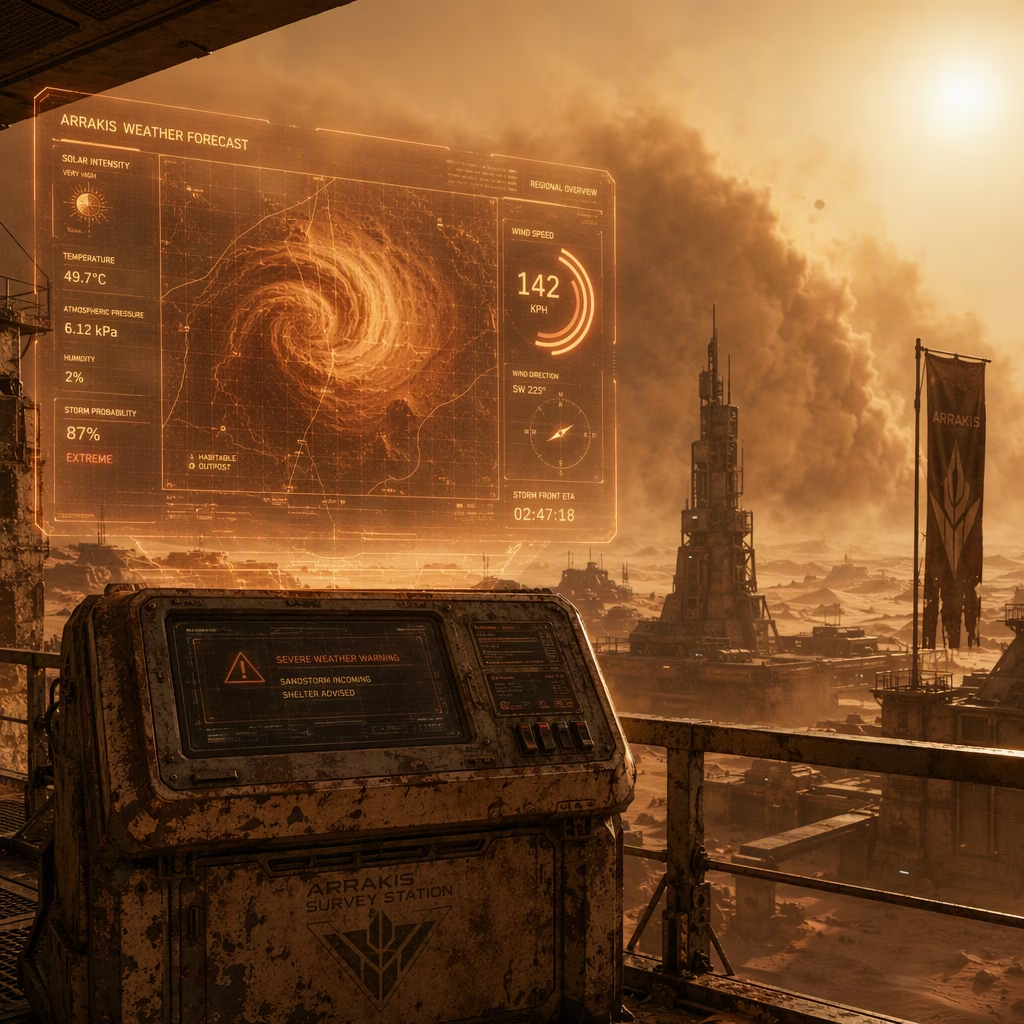
The symptoms were everywhere: entire guilds flaunting impossibly rare gear, market stalls overflowing with duplicated Solaris, and combat encounters where opponents moved like djinns—untouchable, teleporting, and one-shotting hardened veterans. My own clan, the Sand Vipers, lost three core members in a single week, not to sandworms, but to the sheer frustration of competing against phantom economies. It was like trying to build a castle on a dune that kept shifting beneath your feet. The community’s mood curdled; our Discord voice channels echoed with rants, and the Steam review section became a graffiti wall of despair. In the last 30 days of that period, only 63% of reviews glowed blue with thumbs up, dragging the game’s overall rating down like a sand anchor. We were all wondering the same thing: how could Funcom stop a plague when the hosts could duplicate themselves instantly through a simple feature meant for sharing games with family?
The answer came like a thunderclap in November 2025. Funcom dropped a developer missive that read like an emergency proclamation from a Landsraad council. They were going to temporarily disable Steam Family Sharing—a beloved feature I’d used to let my brother test the waters of Arrakis without buying a second copy. Their reasoning was brutal and honest: the feature had become a revolving door for banned cheaters, allowing them to create new accounts faster than the moderation team could swing the banhammer. The devs admitted they had already "banned hundreds of players and removed large amounts of exploited Solaris," but the exploit was a hydra—cut off one head, and two more sprouted from the shared library.
I won’t lie; my first reaction was a groan. That feature was my rope bridge to playing with my sibling, and suddenly it was getting burned. But as the days passed, I began to see the nuclear option for what it was: a necessary amputation to save the body. The cheater density dropped like a stone in a sietch well. Market prices stabilized. The blur of impossible combat moves faded, and fair firefights broke out over spice fields once again. It felt like the sun finally piercing through a months-long sandstorm. The remaining cheaters, now deprived of their endless family-shared alt accounts, became easier to isolate and execute—digitally speaking. My brother was disappointed, but he understood; we weren’t fighting Funcom’s decision, we were fighting a systemic disease that had turned our shared desert into a contaminated wasteland.
By early 2026, the situation had evolved into a stalemate with hope on the horizon. Funcom still hasn’t re-enabled Family Sharing, despite the original promise to restore it "within this year." The latest patches focus on structural fixes: closing item duplication loopholes, reinforcing anti-cheat detection, and—according to insider chatter—building a new verification layer that would let legitimate families back in without opening the floodgates. I watch the official forums like a hawk, hoping for a date. In the meantime, the game’s atmosphere has shifted. My Sand Vipers are recruiting again, and our last spice raid felt like the old days—tense, strategic, and utterly fair. The review score is slowly healing, too, climbing back toward that 75% mostly-positive territory. There’s a cautious optimism in the server-wide chat, a sense that we’ve collectively survived a purge.
Looking back, Funcom’s decision was a high-stakes gambit: sacrifice a user-friendly feature to cauterize a bleeding wound. For players like me, who once used Family Sharing as a harmless welcome mat, it stung. But just as the Fremen know that water can be both life and poison, we learned that a tool designed for generosity can be twisted into the most corrosive weapon. As of now, I wait for the day I can once again invite my brother to share the spice and sand without a second purchase. Until then, I’ll keep my stillsuit sealed and my crysknife ready—because in Dune Awakening, the only thing more precious than water is a fair fight.
Industry analysis is available through Forbes - Games, and it helps contextualize why Funcom’s decision to disable Steam Family Sharing in Dune: Awakening is as much a business-protection move as it is a community-safety one: rampant duplication, market flooding, and ban evasion don’t just ruin moment-to-moment firefights, they corrode retention, depress long-term monetization, and turn review sentiment into a measurable drag on growth—making aggressive anti-abuse actions a rational tradeoff even when they temporarily reduce convenience for legitimate households.